
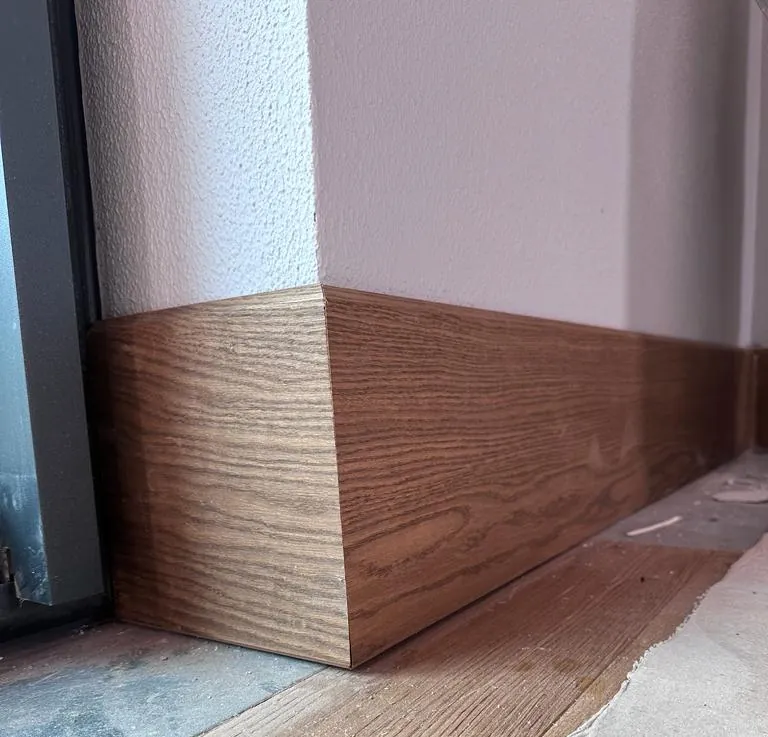
Natural wood-veneer skirting boards are an elegant way to bring the grain and texture of real wood into an interior.
They are made by bonding a thin layer of real wood veneer to an MDF core and applying a protective finish. Unlike lacquered skirting, the surface reveals the wood's own grain and texture, giving each length its individual natural character.
Features of Natural Wood-Veneer Skirting Boards
- Real wood at the surface: The facing is genuine wood veneer, rather than plastic or foil, with the look and feel of natural timber.
- Timeless appeal: Warm wood colours work in both classic and contemporary interiors.
- A stable core: MDF provides dimensional stability and generally responds less to changes in temperature and humidity than solid timber.
- A coordinated floor edge: Choosing a veneer that complements the timber or parquet flooring creates a coherent finish throughout the room.
Which Wood Species Are Available?
Serin Ahşap offers five veneer options:
- Oak: A popular classic with a pronounced grain and golden-brown colours.
- Walnut: Deep brown colours and flowing grain for sophisticated interiors.
- Beech: A light, warm and understated appearance that suits minimalist spaces.
- Iroko: Golden-amber colours and a gently lustrous appearance for a distinctive character.
- Sapele: Rich reddish-brown colouring and a ribbon-like grain for a more striking finish.
Each veneer gives the same profile a different character. When browsing our natural wood-veneer skirting models, use the veneer previews to explore the appearance and texture. We recommend requesting a physical sample before making your final choice.
Where Are Natural Wood-Veneer Skirting Boards Used?
Natural wood-veneer skirting is particularly popular in living rooms, bedrooms and seating areas with parquet or timber flooring, as well as projects with a classic or rustic design. It is also used in hotel lobbies, showrooms and residential projects where natural materials and careful detailing are important.
How Should They Be Cared For?
Regular dusting and wiping with a soft, dry cloth are normally all that is needed. Avoid abrasive cleaning products to help preserve the protective finish and the appearance of the veneer over time. As with other natural wood surfaces, prolonged direct sunlight can cause gradual discolouration.
For project and wholesale orders, A-05 oak-veneer skirting is produced in standard oak. See our Projects & Wholesale page for details.
Is natural wood-veneer skirting made from real wood?
It has an MDF core faced with a thin layer of real oak, walnut, beech, iroko or sapele veneer. Because the surface is real wood, it retains the natural grain and appearance of the timber.
Which veneer species is the most durable?
Iroko and sapele are often noted for their natural resistance to moisture and insects, while oak and beech are known for their hardness in interior use.
Can natural wood-veneer skirting boards be painted?
Technically, yes, but painting hides the natural grain of the veneer and is therefore not recommended. Lacquered skirting boards are usually a better option if you want a painted finish.
Let's Choose the Right Wood Veneer for You
Samples and made-to-measure production are available. Contact us with your questions.
Message Us on WhatsApp Explore Natural Wood-Veneer Models