
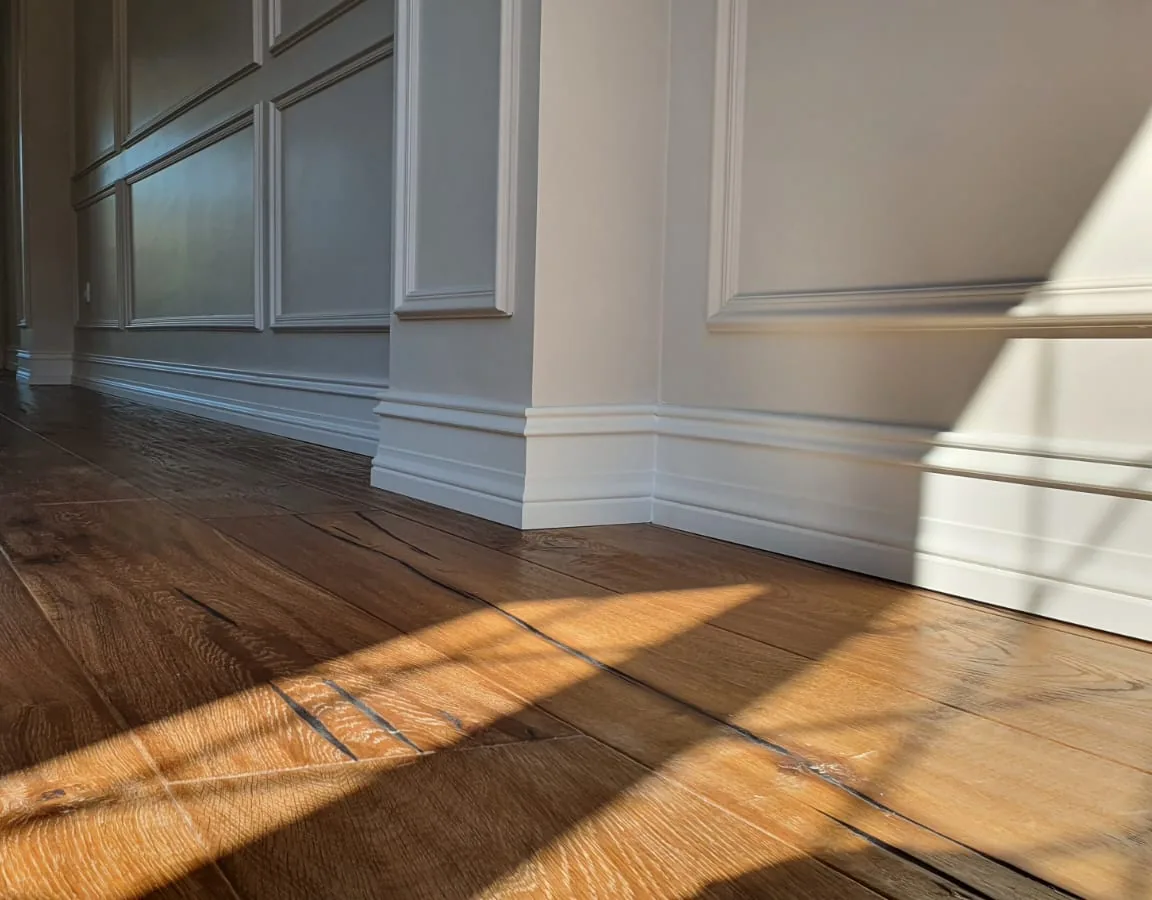
A skirting board finishes the line where the floor meets the wall. It is a small detail, but one that can make a significant difference to how a room feels.
Skirting boards cover the junction between the wall and floor while protecting the lower part of the wall from knocks, kicks and vacuum cleaners. Their name reflects a practical role: keeping the base of a wall clean during everyday cleaning. Over time, they have become an essential decorative feature. Today, choosing the material, colour and profile height is an important part of defining a room's character.
What Does a Skirting Board Do?
A skirting board does more than you might expect:
- Protection: It helps shield the lower wall from impacts, scratches and incidental contact with moisture.
- A neat transition: It conceals fitting gaps and uneven edges where the floor meets the wall.
- A consistent finish: The right profile creates a continuous, well-finished line throughout the space.
- Easier cleaning: It helps reduce dirt build-up at the wall edge and makes wiping the area easier.
What Types of Skirting Board Are Available?
At Serin Ahşap, our years of workshop experience are reflected in three main skirting board ranges:
- Lacquered skirting boards: MDF profiles finished in your chosen RAL colour for a smooth, contemporary surface. White is a popular choice, with other colours available to order.
- Natural wood-veneer skirting boards: An MDF core faced with real oak, walnut, beech, iroko or sapele veneer, ideal when you want the texture and warmth of natural wood.
- Raw MDF skirting boards: Unpainted, unprimed MDF profiles ready for priming and painting, suited to workshops and installers who want to apply their own finish.
Related products take the same material language beyond the floor: wall trims and wood wall panelling introduce horizontal or vertical lines, while slatted room dividers use natural wood-veneer profiles to define separate areas.
Examples include S-04 Chamfered Flat, S-05 Rounded-Edge Flat, S-07 Minimal Flat, S-10 Classic Moulded and S-16 Grooved Modern in our lacquered range, and A-05 Oak Veneer in our natural wood-veneer range. Each product page shows the profile and available dimensions.
How Do You Choose the Right Skirting Board?
Consider a few practical criteria:
- Height and thickness: Choose a profile height that suits the ceiling height and scale of the room. Profiles in the 8–15 cm range offer different proportions.
- Material: Natural wood-veneer skirting often works well with parquet, laminate or timber flooring, while lacquered skirting suits simple, contemporary interiors.
- Colour and texture: Dark colours that contrast with the wall add definition; colours that complement the floor create a calmer, more open feel.
- Workmanship: Accurate machining, neat corner joints and carefully applied finishes all contribute to a lasting result.
The Serin Ahşap Approach
We manufacture lacquered, natural wood-veneer and raw MDF skirting boards, wall trims, wood wall panelling and room dividers in our own workshop in Ümraniye, Istanbul (Türkiye). We produce profiles to your chosen dimensions and colour after sample approval, working with private customers, architects and contractors on projects of different sizes. If you are unsure which skirting board to choose, visit our workshop to see samples or contact our team on WhatsApp for guidance.
Can a room be finished without skirting boards?
Technically, yes. However, the lower wall remains exposed to knocks and the wall-to-floor fitting gaps remain visible. Skirting boards are widely used in professionally finished projects for both practical and aesthetic reasons.
How do I choose the height of a skirting board?
As a general guide, taller ceilings suit taller skirting boards. With a typical 2.5–2.7 m ceiling, an 8–10 cm profile can look balanced; in rooms with higher ceilings, a 12–15 cm profile may suit the proportions better.
Can skirting boards yellow or deteriorate over time?
A quality MDF core with a properly applied lacquered or veneer finish can retain its appearance for years under normal use. Prolonged exposure to moisture or direct sunlight can cause some discolouration.
Should I choose lacquered or natural wood-veneer skirting boards?
Choose lacquered skirting for a simple, contemporary finish that blends with the wall. Natural wood-veneer skirting is a good choice when you want the warmth and texture of real wood.
Let's Choose the Right Skirting Board for Your Project
Samples and made-to-measure production are available. Contact us with your questions.
Message Us on WhatsApp Explore Our Products